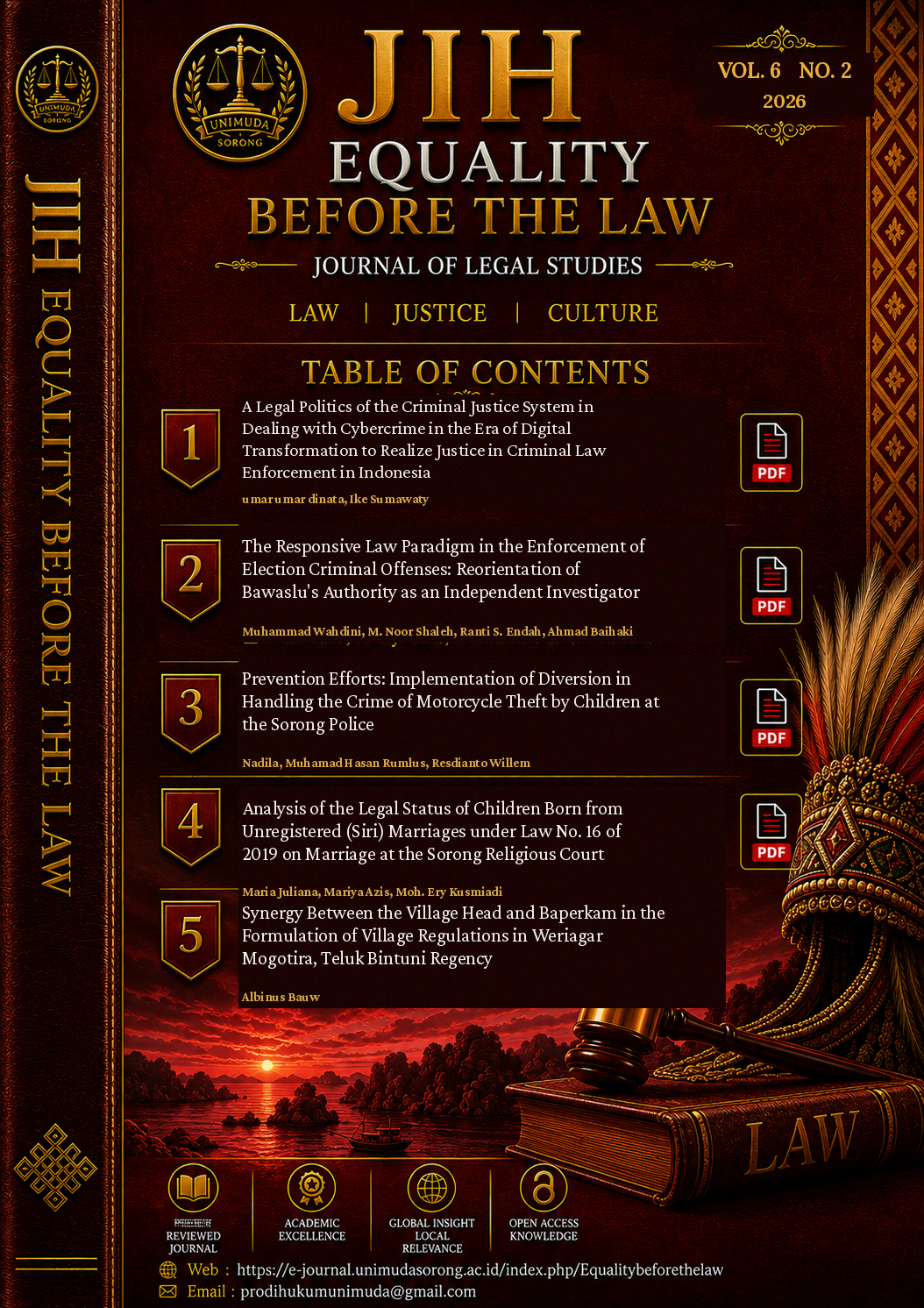
The Responsive Law Paradigm in the Enforcement of Election Criminal Offenses: Reorientation of Bawaslu's Authority as an Independent Investigator
DOI:
https://doi.org/10.36232/ebl.v6i2.6358Keywords:
Responsive Law; Election Criminal Offenses; Bawaslu; Independent Investigator Electoral Justice.Abstract
Enforcement of election-related criminal offenses in Indonesia continues to face various institutional obstacles due to the limited authority of the Election Supervisory Body (Bawaslu), which functions only as a supervisor and reporter, while investigative authority rests with the Police through the Integrated Law Enforcement Center (Gakkumdu). Data from the National Legal Development Agency shows that in the 2019 General Election, only 345 of 2,798 alleged election criminal offenses discussed at the Gakkumdu Center were declared to meet the elements of a criminal offense, indicating that the effectiveness of election criminal law enforcement remains low. This study aims to analyze the philosophical, juridical, and sociological foundations for strengthening Bawaslu's investigative authority through the perspective of the Responsive Law theory of Philippe Nonet and Philip Selznick. This research is normative legal research employing statutory, conceptual, and case approaches, supported by secondary empirical data in the form of official reports from Bawaslu and the National Legal Development Agency, as well as scholarly literature to reinforce the normative analysis. The results show that the current institutional design for enforcing election criminal offenses still reflects the character of autonomous law, oriented toward formal procedure, and thus does not yet fully guarantee substantive electoral justice. From the perspective of Responsive Law, effective law enforcement requires institutions that are adaptive, independent, and oriented toward protecting citizens' political rights. Therefore, reconstructing Bawaslu's investigative authority is regarded as a viable legal policy alternative worth considering through amendments to statutory regulations, while still upholding the principle of checks and balances within the criminal justice system, in order to strengthen electoral integrity and the quality of democracy in Indonesia.References
Abdullah, A. (2022). The Establishment of Special Election Courts in Indonesia Based on the State Principles of Democratic Law. 9th Asbam International Conference (Archeology, History, & Culture In The Nature of Malay)(ASBAM 2021), 573–579.
Aermadepa, A., Puspitaningrum, J., Dananjaya, P. B., Ferricha, D., Yunaldi, W., Permadhi, P. L. O., Firmanto, T., Ahmad, A., Muslim, I., & Abustan, A. (2024). Penegakan hukum pemilu di Indonesia: Tantangan dan prospek keberlanjutan demokrasi. PT. Sonpedia Publishing Indonesia.
Alexy, R. (2021). Gustav Radbruch’s concept of law. Law’s Ideal Dimension, 26(1946).
Antari, P. E. D., & Mahendra, I. G. R. (2025). Upaya Pengawasan Badan Pengawasan Pemilu (Bawaslu) Kabupaten Badung dalam Pencegahan dan Penindakan Pelanggaran Pemilu Tahun 2024. Humanism: Jurnal Pengabdian Masyarakat, 6(1), 17–49.
Ariani, S. A. F., & Prasetyoningsih, N. (2022). Fighting Corruption Post Revision of the Act of the Corruption Eradication Commission. Media of Law and Sharia, 3(3), 235–254.
Banjarnahor, D. N. (2024). Gagasan Penataan Ulang Penegakan Hukum Pemilu dan Pilkada untuk Mewujudkan Pemilu Berintegritas Menuju Negara Hukum Indonesia yang Demokratis. Konferensi Nasional Asosiasi Pengajar Hukum Tata Negara Dan Hukum Administrasi Negara, 2(1), 699–722.
Daeli, F., Winarni, H., & Umar, R. (2024). Penanganan Tindak Pidana Pemilu Di Daerah Istimewa Yogyakarta Melalui Implementasi Wewenang Sentra Gakkumdu (Penegakan Hukum Terpadu). Fortiori Law Journal, 4(2), 100–117.
Faizal, L. (2023). The Problems in Implementing the Function of the Integrated Law Enforcement Center (Gakkumdu) as an Election Law Enforcement Institution. As-Siyasi: Journal of Constitutional Law, 3(2), 199–213.
Hayckel, E., Paskarina, C., & Solihah, R. (2024). Peran prinsip-prinsip fundamental penyelenggaraan pemilu dalam meningkatkan integritas badan pengawas pemilihan umum. JANE-Jurnal Administrasi Negara, 16(1), 99–109.
Heriyadi, H., Utama, Y. J., & Prasetyo, D. (2023). Juridical Review of The Role and Functions of The Financial Services Authority (OJK) in The Financial System in Indonesia. Journal of Hunan University Natural Sciences, 60.
Hiariej, E. O. S. (2021). Asas lex specialis systematis dan hukum pidana pajak. Jurnal Penelitian Hukum De Jure, 21(1), 1–12.
Iqsandri, R. (2022). Pengaruh politik terhadap proses penegakan hukum di Indonesia. Criminology and Justice, 2(1), 1–3.
Is, M. S. (2024). Penguatan Fungsi Bawaslu Dalam Penegakan Hukum Pelanggaran Administrasi Sebagai Penataan Pemilu Serentak. Proceeding APHTN-HAN, 2(1), 263–294.
Jamaluddin, J. (2022). The Settlement of Election Disputes by Bawaslu Reviewed from the Indonesian Justice System. Interdisciplinary Social Studies, 1(5), 521–531.
Junaidi, M. (2020). Tindak Pidana Pemilu Dan Pilkada Oleh Sentra Penegakan Hukum Terpadu. Jurnal Ius Constituendum, 5(2), 220–234.
Kambu, F., Rakia, A. S. R. S., & Yati, S. (2025). Reinterpretasi Imunitas DPR dalam Sistem Ketatanegaraan Indonesia: Harmonisasi Prinsip Equality Before the Law. Jurnal USM Law Review, 8(1), 304–319.
Karimullah, S. S. (2024). The role of law enforcement officials: The dilemma between professionalism and political interests. Jurnal Hukum Dan Peradilan, 13(2), 365–392.
Lubis, M. T. S., Saragih, R., Hanifah, I., Koto, I., & Jacob, J. T. (2023). The Criminal Law Policy On The General Election System In Indonesia. Jurnal Dinamika Hukum, 23(3), 587–600.
Musdalifah, D. A., Rahmawati, A. E., Sha’idah, Z. A., Sulistianingsih, D., & Martitah, M. (2024). Dehumanisasi penerapan hukum pidana secara berlebihan (overspanning van het strafrecht) berdasarkan teori social engineering. Bookchapter Hukum Dan Politik Dalam Berbagai Perspektif, 3, 228–252.
Nasional, B. P. H., & RI, K. H. D. (2020). Laporan Akhir Analisis dan Evaluasi Hukum Terkait Pemilihan Umum. Jakarta: Badan Pembinaan Hukum Nasional Kementerian Hukum Dan HAM RI.
Novitasari, S. Y., Fathorrahman, F., & Najib, A. (2025). Penegakan Hukum Pemilu terhadap Praktik Politik Uang di Indonesia. Hukum Inovatif: Jurnal Ilmu Hukum Sosial Dan Humaniora, 2(1), 369–381.
Nurhakim, I., & Huda, U. N. (2025). Politik Hukum Pemilu Di Indonesia: Pergeseran Dari Rule By Law Menuju Rule Of Law Dalam Konfigurasi Politik Dan Demokrasi Substantif. Indonesian Journal of Islamic Jurisprudence, Economic and Legal Theory, 3(4), 3488–3506.
Philona, R., & Awaludin, A. (2025). Constitutional Values and Restorative Justice: A Critical Analysis in the Indonesian Context. KARSA Journal of Social and Islamic Culture, 33(1), 241–271.
Ramadhani, S., & Syafriyani, I. (2025). Implementasi Kebijakan Undang-Undang Nomor 7 Tahun 2017 Tentang Netralitas Kepala Desa Dalam Pemilihan Umum Di Kecamatan Dungkek Kabupaten Sumenep. Prosiding Seminar Nasional Fakultas Ilmu Sosial Dan Ilmu Politik, 2(1), 177–192.
Rois, N. (2024). Mewujudkan Hukum Sebagai Panglima di Indonesia dalam Perspektif Hukum Responsif Philippe Nonet dan Philip Zelsnic. Jurnal Dinamika, 4(1), 38–54.
Rusmana, I. P. E. (2024). Kewenangan Antara Bawaslu Dan Aparat Penegak Hukum Dalam Penanganan Tindak Pidana Pemilu. Jurnal Rechtens, 13(2), 261–284.
Sarkani, M., Apriandi, M., & Yuningsih, H. (2025). Handling of General Election Crimes in the Framework of Realizing Democratic and Responsible General Elections. Khazanah Sosial, 7(1), 32–50.
Seac, A. E. F. (2022). Penguatan Bawaslu Dalam Penegakan Hukum Pidana Pemilu. Fianosa Publishing.
Selznick, A. P. N. (n.d.). Relasi Hukum dan Kekuasaan Analisis Pemikiran Nonet Selznick.
Simanjuntak, B., Sinaga, S., Manullang, T., & Pasaribu, M. (2026). Teori Hukum sebagai Instrumen Analisis Normatif dan Sosiologis. Journal of Multidisciplinary Law Studies, 1(1), 56–65.
Sukma Wijaya. (2026). Aparatur Sipil Negara (ASN) Tidak Menggunakan Hak Pilih Dalam Pemilu Dan Pemilihan. Equality Before The Law, 6(1).
Susanto, A. (2025). Wawancara.
Taufiqurrahman, F., Ibnususilo, E., & Melina, M. (2023). Pergesaran penegakan hukum yang positivistik menuju ke penegakan hukum yang progresif. Journal Equitable, 8(1), 159–183.
Taufiqurrahman, T., Hasanah, S., & Jiwantara, F. A. (2023). Sistem Penyelesaian Sengketa Pemilihan Umum Di Negara Hukum Demokrasi (Studi Komparatif). Jatiswara, 38(2), 241–254.
Umam, A. H. (2026). Rekonstruksi Keadilan Perspektif Teori Hukum Progresif Di Indonesia. El-Dusturie, 5(1), 39–52.
Wahdini, M., & MH, M. (2022). Pengantar metodologi penelitian hukum. Yogyakarta: Penerbit K-Media.
Wakid, M., Jaelani, A., & Rahman, A. (2026). Efektivitas Crime Process dalam Penegakan Hukum Pemilu: Analisis Faktor Penyebab Tingginya Angka Penghentian Kasus di Tahap Penyidikan. Eksekusi: Jurnal Ilmu Hukum Dan Administrasi Negara, 4(1), 168–178.
Waluyo, B. (2022). Penegakan hukum di Indonesia. Sinar Grafika.
Wicaksono, H., & Han, M. (2026). Perang Melawan Politik Uang: Peran Pengendalian Sosial dalam Demokrasi Indonesia. Detak Pustaka.
Yusuf, A., Herman, H., Namruddin, R., Jumarlis, M., Jusran, J., & Mirfan, M. (2026). Rekonstruksi Hukum Pidana Pemilu melalui Kerangka Keadilan Elektoral di Indonesia. Jurnal Tana Mana, 7(1), 570–582.
Downloads
Published
Issue
Section
License
Copyright (c) 2026 Muhammad Wahdini, Muhammad Noor Shaleh, Ranti Suminar Endah, Ahmad Baihaki

This work is licensed under a Creative Commons Attribution-NonCommercial 4.0 International License.